
Most companies that introduce a configurator start in the same place: with the configurator. It seems logical. That is where the product knowledge lives, and that is what the internal experts understand best. From the customer’s point of view, it is exactly the wrong place to start.
This page describes the order that works — guided selling, selector, configurator — and the one mistake that undoes it if the stages are not connected.
Why the internal view leads to the wrong start
Internally, people like to jump straight into configuration, because they know the product. And that is exactly the view from which most configurators are designed. The customer stands somewhere else entirely:
The internal view
- We know our product range by heart.
- We think in series, variants and part numbers.
- So we start with the configurator — where our knowledge lives.
The customer’s view
- I do not know the products.
- I do not know what is possible.
- I do not know which series could even be considered — let alone which product.
A configurator designed from the inside expects the customer to arrive knowing the series, the variant and the options. Most customers arrive knowing their problem. The gap between the two is where they give up.

Three stages, in this order
A good customer journey for technical products runs through three stages. Each one answers a different question — and each one narrows the choice for the next:
Each stage narrows the choice — and only the last one needs the full depth of the product.
Stage 1 — Guided selling: the rough overview
Guided selling gives the customer an overview. It asks about the situation — the application, the building, the requirement — and points to the product families that fit. No technical knowledge is needed, and none is expected.
For many companies, this is where it ends — and for many customers, that is enough. They know which family to look at, and the sales team takes it from there. How guided selling works in detail is described in Guided Selling: How to Lead Customers to the Right Product.
Stage 2 — The selector: calculated matches
The selector is the second stage. It searches for suitable products using parameters — and it is often confused with the filter in an online shop. The difference is fundamental: a filter excludes, a selector calculates.
| Shop filter | Selector | |
|---|---|---|
| What it does | Hides products whose attributes do not match | Calculates which products meet the requirement |
| Input | Attribute values the customer has to know | Operating parameters the customer actually has |
| Logic | Equal, greater, smaller | Physics, curves, tolerances, combinations |
| Result | Everything that is not excluded | A ranked short list that fits very well |
| Example | Power ≥ 4 kW | Duty point 18 m³/h at 45 m → best efficiency at that point |
A filter can only work with what the customer already knows about the product. A selector works with what the customer knows about the application — and does the translation itself.
Because it calculates, a selector finds products that usually fit very well — often better than a manual search, because it compares every candidate against the same requirement.
Stage 3 — The configurator: what can be built
In industry it is not unusual for a requirement to go beyond anything a standard product can do. That is where configuration is needed. The configurator shows what is feasible and can actually be built — and it does far more than offer options:
This is the stage where the full depth of the product is needed — and where the customer finally sees it assembled into something that fits their requirement:
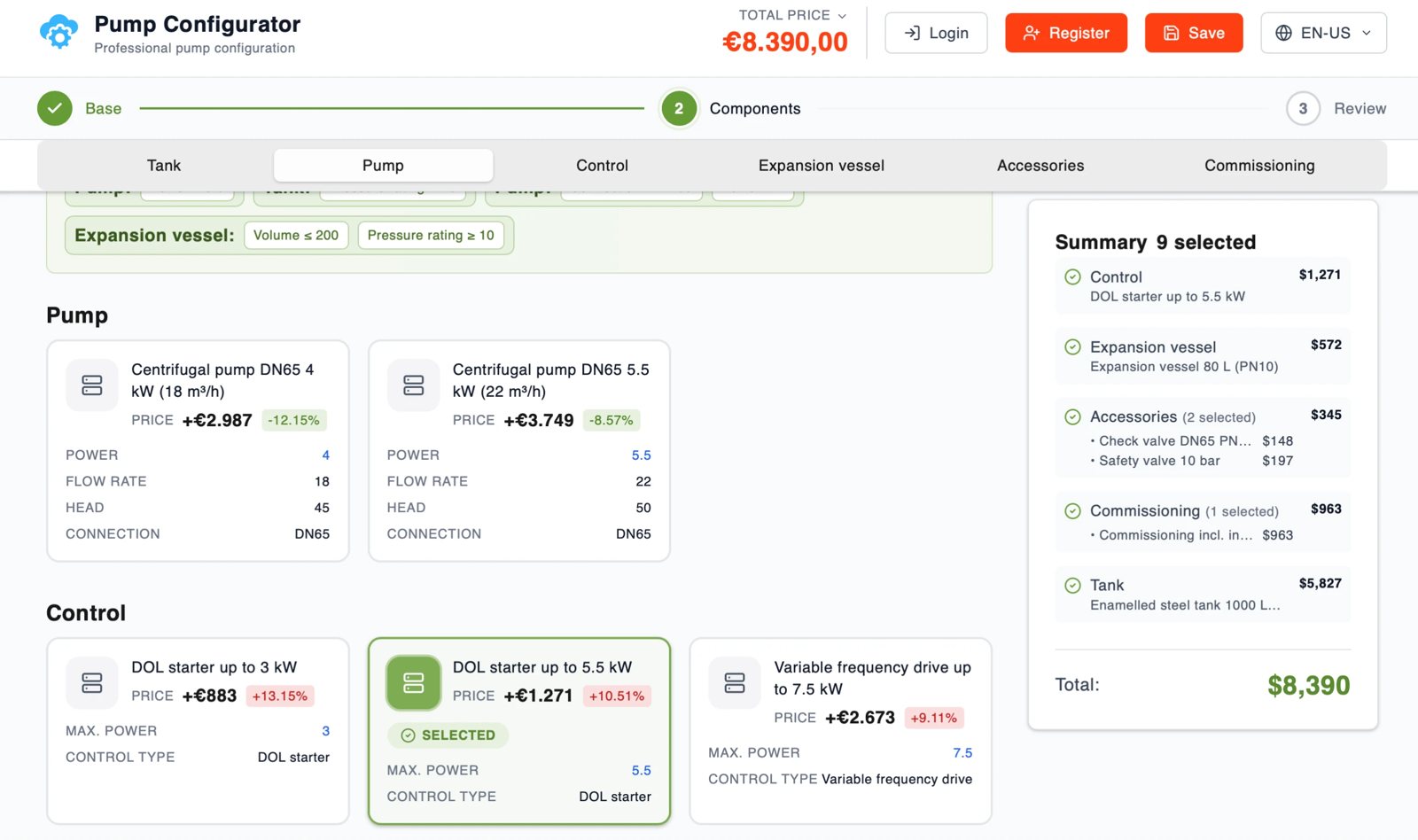
Because the configuration, the BOM and the drawings are held in one system, a change takes minutes — and goes on to production without being retyped.
The one-way mistake
This is where many companies lose what they have built. Processes often run in one direction only and are not coupled. In practice that means: something is wrong — cancel it — create a new enquiry. Every correction starts again from zero.
One way
Every correction starts again from the beginning — data is re-entered, history is lost, and the customer waits.
Coupled
Every stage can go back one step: the configuration is changed, the quotation, BOM and drawing follow automatically.
A coupled system works the other way: each stage can go back to the previous one. The configuration is corrected, and the quotation, the bill of materials and the drawing follow automatically. Nothing is cancelled, nothing is re-entered, the history stays complete.
Whoever masters this has no problems — and lets the system work for them.
What it is worth
A connected chain of guided selling, selector and configurator is not a small project, and sometimes it is a significant investment. It is worth it when the products are complex, the quotations are frequent and errors are expensive — which describes most industrial manufacturers.
Cheap shortcuts exist: a filter instead of a selector, a spreadsheet instead of a configurator, one-way processes instead of coupled ones. They cost little — and they are usually worth about as much. What costs nothing is rarely worth much.
Checklist: are your stages in the right order?
- Can a customer who does not know your products find the right product family?
- Does your selector calculate — or does it only filter attributes?
- Does your configurator only offer what can actually be built?
- Does it calculate, create the BOM and the production drawings?
- Can a configuration be changed after the quotation without cancelling and starting again?
Where does your customer journey start today? In a free demo we look at your product range and show how guided selling, selector and configurator would work together for it.