
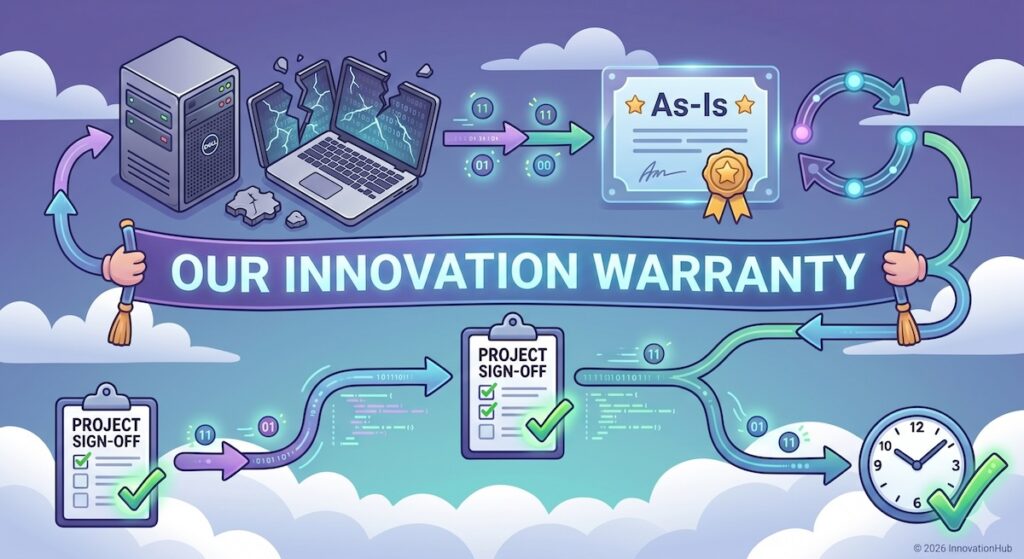
Have you ever asked your IT supplier for a “warranty of implementation”?
Most of the time, the answer is something like:
“Let’s start and you pay per hour.”
It sounds flexible, but in reality it shifts all the risk to the client. There is no fixed outcome, no clear guarantee — just ongoing effort and uncertainty.
And that’s exactly where many IT projects struggle.
Even with AI speeding things up, IT projects remain complex. The real challenge is not building software quickly, but making sure software, data, and real usage actually work together.
What often happens instead: solutions are “assembled” to get them delivered on time. Technically finished — but not really adopted or fully used.
That’s why many companies fall back to standard products. It feels safer and more predictable. But there is a downside: everything starts to look the same.
The same interfaces. The same workflows. The same limitations.
And in customer-facing products, that becomes a real problem — because differentiation disappears.
In our projects, we take a different approach.
Instead of open-ended hourly models, we work with a fixed scope and a clear commitment to delivery. That means we agree upfront on what will be built, and we take responsibility for making it work as defined.
For example:
A company wants a custom customer portal with a very specific user journey and UI. Instead of adapting to a standard template, the design and functionality are defined together upfront. The result is not a compromise of existing software, but a solution built around the actual needs.
Or a business needs to connect multiple data sources into one clean application. Instead of iterative hourly development with shifting expectations, the integration scope is defined clearly — and then implemented as agreed.
The goal is simple: reduce uncertainty in execution.
Because in IT, the idea is usually not the problem.
Execution is.